Disclosure: This post contains affiliate links. If you click through and make a purchase, PawNationFinds may earn a commission at no extra cost to you.
The doorbell rings, and within half a second your dog is at the door at full volume. It’s one of the most universal dog behaviours there is — and one of the most trainable, because it follows a predictable pattern. The doorbell isn’t really the problem. The problem is everything your dog has learned the doorbell means.
Quick Answer: Dogs bark at the doorbell because the sound predicts excitement — visitors, delivery people, attention — and because barking has always been followed by the door opening, so it feels like the barking “works.” The fix has three parts: desensitize your dog to the sound itself, teach a place/settle routine as the replacement behaviour, and practise the whole sequence calmly before a real visitor tests it.
Why do dogs bark at the doorbell?
For most dogs it’s a mix of alerting and learned excitement. The doorbell is a loud, unusual sound that only happens when something is about to change — a guest, a package, a reason for everyone in the house to move toward the door. Dogs are excellent pattern-spotters. After a few repetitions, the bell doesn’t just announce a visitor; in your dog’s mind, the bell causes the exciting event.
There’s also a reinforcement loop. The dog barks, the door opens, the visitor comes in. From the dog’s point of view, barking is part of how doors work. Shouting “quiet!” over the top usually doesn’t help either — to the dog, it can sound like you’re joining in.
Step one: how do I desensitize my dog to the doorbell sound?
Desensitization means teaching your dog that the sound, on its own, is boring. You separate the bell from the event it predicts.
- Find a recording of your doorbell sound (or record yours) on your phone.
- Play it at a very low volume — low enough that your dog notices but doesn’t react. Reward calm behaviour.
- Repeat over several short sessions, raising the volume a little at a time as long as your dog stays relaxed.
- If your dog reacts strongly at any level, drop back to the previous volume. Rushing this step is the most common mistake.
A few calm minutes a day is plenty. You’re rewiring an association, and that happens through repetition, not marathon sessions.
Step two: what is a “place” routine, and how do I teach it?
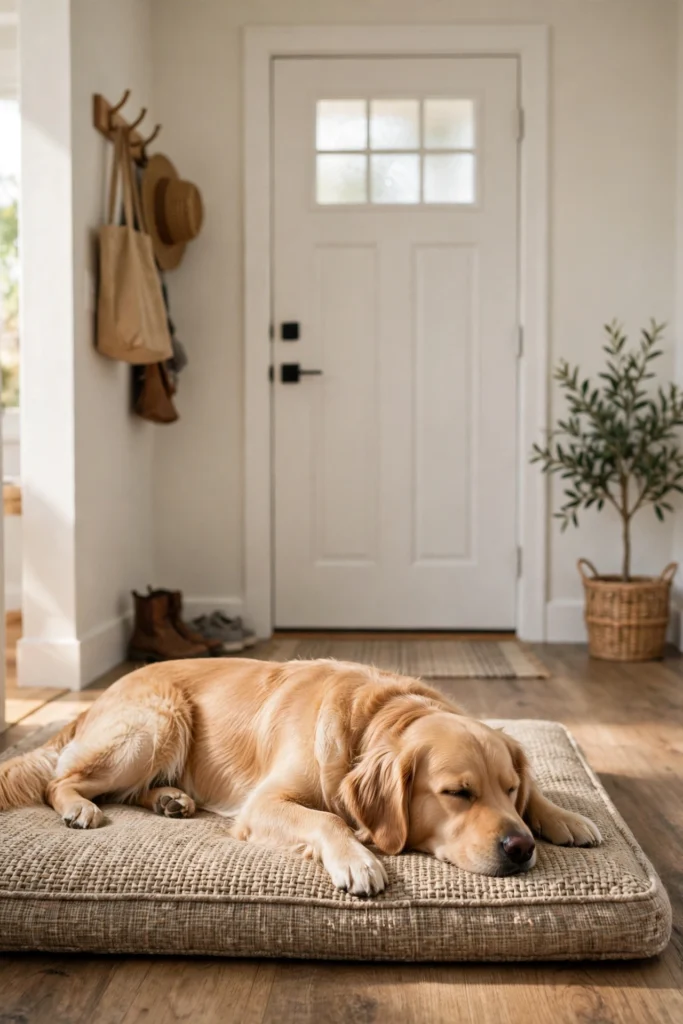
A place routine gives your dog a job to replace barking: when the doorbell rings, go to a mat or bed, lie down, and settle. You’re not just asking for less barking — you’re teaching a specific alternative behaviour.
- Pick the spot: a mat or bed a few metres from the door, out of the direct path of visitors.
- Without the doorbell, lure or guide your dog to the mat, reward them for stepping on it, then for lying down, then for staying a few seconds.
- Build duration gradually — a few seconds, then thirty, then a couple of minutes — rewarding calm behaviour on the mat.
- Only once the routine is solid without the bell, pair it with a quiet, low-volume doorbell recording, then normal volume.
- Practise with a household member ringing the bell and coming in calmly before you ever rely on it with a real guest.
Step three: what do I do when the doorbell actually rings?
Keep it boring. If your dog holds the place routine, reward that calmly. If they break and bark, don’t punish — just reset: guide them back to the mat once things settle, and make the next practise session easier. Real visitors are the exam; most of the learning happens in the practise sessions.
Management helps while training is in progress: a note on the door asking visitors to text instead of ringing buys you time to train instead of rehearsing the barking every day.
Where does general training fit in?
Doorbell barking is one symptom of a broader pattern: a dog that hasn’t learned to check in with its owner and settle on cue will struggle with most excitement triggers, not just the bell. The K9 Training Institute’s free workshop teaches those foundations — body language, check-ins, and calm settle behaviour. It isn’t a doorbell-specific program, but the underlying skills are the same ones the place routine above is built on. Our K9 Training Institute review explains the method in detail, and more behaviour guides live in our dog training and behaviour section.
FAQ
How long does doorbell training usually take?
It depends on how rehearsed the barking habit is and how often you practise. Short daily sessions over a few weeks is a realistic expectation for noticeable improvement; dogs with years of doorbell practice behind them generally need longer.
Should I punish my dog for barking at the door?
No. Punishment tends to raise arousal around visitors, which can make door behaviour worse. Teaching a replacement behaviour — the place routine — works on the actual cause.
What if my dog barks at knocks and deliveries too, not just the bell?
Train each sound the same way: desensitize to a recording at low volume, and use the same place routine for every door event, so your dog learns one rule — door sounds mean “go to my mat.”
When should I get professional help?
If the barking comes with lunging, snapping, guarding the door, or genuine fear and panic, bring in a qualified professional trainer. That’s beyond doorbell manners and deserves in-person assessment.